There is a shift happening in aesthetic medicine and, it is one of the most important conversations we have had in this field in a decade.
Patients are no longer arriving and asking: What can you do to fix this?
They are arriving and asking: How do I keep what I have? How do I stay ahead of this? How do I look well for a long time?
This is the longevity shift. And at First Impressions Rejuvenation Clinic, it is exactly how we have always thought about your care.
What Skin Longevity Actually Means
The term longevity gets used a great deal right now, in wellness culture, in skincare marketing, in aesthetics. And like most things that become popular, it risks losing its clinical precision.
So let us be specific.
Skin longevity refers to maintaining the structural integrity, resilience, and function of the skin over time. It is not about looking young. It is not about defying biology. It is about supporting the systems your skin uses to repair, regenerate, and respond, so that each decade builds on the one before it rather than working against it.
This represents a move away from treating visible signs of aging reactively and toward preserving optimal skin function proactively. Preventative care over corrective care. Functional skin health over surface-level improvement.
This distinction is not a marketing preference. It is a clinical one.
Why Starting Earlier Changes Everything
One of the most common questions we receive is some version of: Am I too young to be thinking about this?
The short answer: no. You are almost certainly not too young.
Collagen production begins declining in your mid-twenties, gradually at first, then more noticeably across your thirties and forties. By the time visible changes appear in the skin, the underlying structural changes have often been progressing for years. The skin you see today is the result of choices and conditions from five to ten years ago.
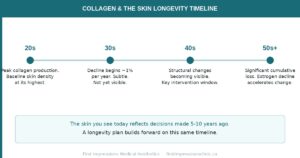
Preventative aesthetic care works on this timeline. It addresses the structural environment before it becomes a visible problem.
This does not mean everyone should be in a treatment chair in their mid-twenties. It means that when you begin thinking about skin health in the context of your overall wellbeing, as something to maintain rather than something to correct – the results over time are meaningfully different.
Patients who invest early in skin quality, collagen stimulation, and barrier function tend to need less over time. Results are subtle, cumulative, and sustainable. They do not arrive looking like they had something done. They arrive looking like themselves, just continuously well.
The Biological Foundation: What We Are Actually Supporting
Collagen and Structural Resilience
Collagen is the scaffolding of the skin. It provides density, elasticity, and the structural support that allows everything above it to sit correctly. The regenerative aesthetics movement increasingly frames treatment not as adding to the face but as maintaining the conditions under which the skin can support itself.
Collagen stimulation and structural support are the foundation of every lasting result. When we protect and stimulate collagen proactively, the skin maintains its architecture. When we wait until the architecture has already shifted, we are working against structural loss rather than preventing it.
The Role of Inflammation
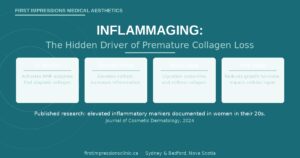
Dermatologists increasingly emphasize preventative routines that strengthen the skin barrier, reduce inflammation, and support collagen production, because chronic low-grade inflammation is one of the most significant drivers of structural breakdown. Common contributors include UV exposure, sleep disruption, blood sugar instability, and environmental stressors.
In practice, this means a longevity plan does not live entirely in the treatment room. Lifestyle factors are part of the clinical conversation, not because we are telling patients how to live, but because the skin reflects what the body is managing. An aesthetics plan that ignores this is working with less than half the information.
PRP/PRF: When Your Biology Is the Treatment
PRP/PRF uses your own biology to prime the skin before it needs intervention. Platelet-rich plasma and fibrin activates growth factors that stimulate fibroblast activity, improve vascular supply to the tissue, and support collagen formation from within. It is not corrective, it is preparatory and regenerative.
For patients committed to a longevity approach, PRP/PRF represents the most aligned treatment philosophy available: using the body’s own mechanisms, amplified.
Where Neuromodulators Fit a Longevity Plan
Neuromodulators are often discussed purely as wrinkle treatments. In a longevity framework, their role is more strategic.
Repetitive facial movement creates mechanical stress on collagen fibers over years. Neuromodulators, used precisely and conservatively, protect collagen from repetitive strain, not by eliminating expression, but by softening the degree of repeated mechanical load in areas where it accumulates fastest.
This is preventative neuromodulation. It is not about looking frozen. It is about protecting the structural environment so that the face maintains its integrity over a longer timeline.
Patients who begin conservative neuromodulator care earlier often require less product over time and maintain a more naturally refreshed appearance, because the underlying collagen was never subjected to the same degree of cumulative strain.
The 4-Phase Longevity Framework
At First Impressions, we do not think about skin treatment as a series of individual appointments. We think about it as a plan – one that builds progressively and intentionally over time.
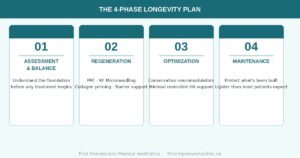
Phase 1 – Assessment and Balance: Every plan begins here. What is the current state of the skin? What is the structural foundation? What does this person’s unique anatomy and history tell us about where support is needed and where restraint is the right clinical call? There is no longevity plan without this first.
Phase 2 – Regeneration: This is the investment phase. PRP/PRF, collagen priming, medical-grade skin health work, and barrier optimization. The goal is to improve the environment, to create conditions that allow every subsequent treatment to deliver more, last longer, and integrate more naturally.
Phase 3 – Optimization: Once the foundation is established, refinement becomes possible. Conservative neuromodulation, minimal structural HA support where clinically indicated, and ongoing skin quality maintenance. Less is genuinely more at this stage, because the foundation is doing the work.
Phase 4 – Maintenance: Protecting what has been built. This phase looks different for everyone depending on their biology, lifestyle, and goals. For some patients, it is an annual PRP/PRF session and periodic neuromodulators. For others, it is quarterly check-ins with minimal intervention. The goal is to sustain, not to keep adding.
The patients who experience the most natural, lasting outcomes are almost never those who came in for reactive treatment. They are the ones on a plan.
What This Means for Pre-Summer Skin
There is a natural seasonal rhythm to skin awareness. As light changes and visibility increases, patients begin thinking more consciously about their skin. This is a clinically meaningful moment, not because summer demands intervention, but because it is a natural checkpoint.
A pre-summer assessment is an opportunity to evaluate the current state of the skin, confirm that any existing treatments are performing as intended, and make considered decisions about what – if anything – makes clinical sense to add.
It is not a sale. It is not a seasonal promotion. It is a clinical conversation, the kind that positions every treatment decision in the context of a longer-term plan.
This is the standard we hold for every patient. And it is the standard we will continue to hold regardless of what the calendar says.
The Takeaway
Longevity in aesthetics is not a trend. It reflects a deeper shift toward preventative care over corrective care, toward preserving what is functional rather than simply correcting what is visible.
If you have been thinking about your skin as something to fix when it breaks down, this is an invitation to think about it differently. The distinction between skin quality and surface correction, which we explored in depth in our previous post, is the same distinction at the heart of a longevity plan.
Invest in the foundation. Support the structure. Work with the body rather than against it.
That is what lasting results look like.
– Your First Impressions Team
Ready to build your longevity plan? Book a consultation at firstimpressionsclinic.ca – Sydney and Bedford locations available. | Sydney: 902-322-6805 | Bedford: 902-702-2727