
Healthy Aging Is No Longer About Looking Different
For decades, aesthetic medicine was often centered around a single goal: making signs of aging disappear. Lines were filled. Wrinkles were frozen. Volume was added. The focus was frequently on correcting what time had already changed.
While these treatments still have a meaningful place in modern practice, something significant is shifting. Patients are more informed than ever before. Research continues to advance. And clinicians who take a long view of facial health and skin biology are asking a different question than they were ten years ago.
Rather than chasing individual wrinkles or attempting to erase every sign of aging, more people are seeking strategies that support healthy aging, regenerative collagen production, tissue longevity, and confidence that actually lasts.
I am Deborah Hart, Nurse Practitioner and founder of First Impressions Medical Aesthetics and Rejuvenation Clinic. In over three decades of clinical practice, the question I hear most consistently from patients is not “how do I look younger?” It is: “how do I keep looking and feeling like myself – just healthier?” That question is at the heart of regenerative aesthetic medicine. And this is why it matters now more than ever.
Why Summer Is When Aging Accelerates
Most people associate summer with looking healthier. We spend more time outdoors, we feel more energized, and the warmth tends to lift our overall sense of vitality. But from a skin biology perspective, summer is also one of the seasons when visible aging progresses most rapidly.
Ultraviolet radiation is one of the leading drivers of photoaging, a process that affects far more than surface pigmentation. Repeated UV exposure contributes to collagen degradation, elastin breakdown, skin thinning, pigment irregularities, uneven texture, and progressive loss of elasticity. Research has consistently demonstrated the role of UV exposure in accelerating collagen degradation and visible skin aging.
This is not a reason to stay indoors. It is a reason to invest strategically in the biological structures that keep skin healthy, resilient, and youthful over time, and to understand that what you do between appointments matters just as much as the appointments themselves.
Protecting and supporting skin health during summer is one of the most effective investments you can make in your future appearance. The goal is not simply avoiding damage. It is preserving and actively regenerating the foundation of healthy skin.
The Shift From Anti-Aging to Healthy Aging
One of the most meaningful changes occurring within aesthetic medicine is a philosophical one. Many clinicians, myself included, have moved away from the language of “anti-aging.” And the reason is straightforward: aging itself is not a disease.
Aging is a natural biological process. The objective is not to stop it. The objective is to age well.
Healthy aging in an aesthetic context focuses on skin quality, tissue integrity, facial harmony, collagen preservation, and confidence. It focuses on function and overall wellness rather than the erasure of every line. And when we work with the body rather than against it, results tend to be more natural, more sustainable, and more aligned with how patients actually want to look and feel.
Patients tell me consistently that they do not want to look like someone else. They want to look refreshed, vibrant, and recognizably themselves. That is the goal. And it is a goal that regenerative medicine is genuinely well positioned to achieve.
Results You Can See & Results That Last
Something worth addressing directly: regenerative and longevity-focused care does not mean you will be waiting months to see any results. Many of the treatments we offer at First Impressions produce visible, satisfying outcomes relatively quickly. Neuromodulators work within days. Well-placed hyaluronic acid filler creates immediate improvement in facial volume and balance. These are real results, and they matter.
What regenerative care adds to this equation is longevity and depth. Treatments such as PRF/PRP and RF Microneedling work by stimulating your own biology over time, improving skin quality, building collagen architecture, and creating tissue health that supports and extends everything else you invest in. The result at month three is still improving at month six. That is not a limitation. That is biology working correctly.
The most effective treatment plans combine both: the prompt results that give patients immediate confidence, and the regenerative work that ensures those results have the best possible foundation to build from and last within. They are not competing philosophies. They work together.
Understanding Collagen: The Foundation of Youthful Skin
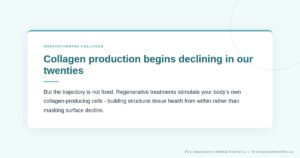
If there is one concept that defines regenerative aesthetics, it is collagen. Collagen is the most abundant structural protein in the body and plays a central role in skin firmness, elasticity, strength, tissue support, and healing. Studies have confirmed that collagen-producing fibroblast activity decreases measurably beginning in early adulthood, and this process accelerates with UV exposure, lifestyle factors, and hormonal changes over time.
The practical result of declining collagen is gradual: fine lines deepen, skin laxity increases, the structural support beneath the face begins to shift. What we may attribute to aging alone is often a combination of structural collagen loss, volume redistribution, and years of cumulative UV exposure.
Modern regenerative treatments are designed to address this at the biological level, stimulating the body’s own collagen production rather than simply masking its decline. The goal is to encourage genuine tissue improvement rather than create temporary change.
Regeneration Versus Replacement

Traditional aesthetic treatments often operate on a replacement model: something has been lost, so something is added. This approach has real value, and we use it thoughtfully at First Impressions when it serves a patient’s goals.
Regenerative medicine asks a complementary question: how can we encourage the body to restore and strengthen its own tissues? Rather than replacing what has been lost, regenerative therapies harness natural healing mechanisms that already exist within the body.
The intersection of skin quality and collagen health has been a consistent thread through our clinic’s approach to patient care. Treatments such as PRF/PRP and RF Microneedling exemplify this regenerative philosophy in practice, and they represent options that work with your biology rather than introducing materials that bypass it.
This philosophy extends naturally from the principles of preventative aesthetic care we have explored throughout this year. Prevention and regeneration are not separate ideas. They are two aspects of the same commitment to long-term skin and tissue health.
PRF/PRP: Your Own Biology, Amplified
Platelet-rich plasma (PRP) and platelet-rich fibrin (PRF) are among the most exciting tools in regenerative aesthetics – and among the most clinically principled, because they use nothing foreign. These treatments draw from a patient’s own blood, concentrate the growth factors naturally present in platelets, and reintroduce them where they can do the most good.
Published research supports the role of platelet-rich fibrin in stimulating growth factor activity associated with tissue regeneration. At the clinical level, this translates to improved skin quality, enhanced texture and hydration, support for hair restoration, and a gradual improvement in the overall health and resilience of treated tissue.
Patients often appreciate that PRF/PRP works with their own biological resources rather than introducing synthetic materials. Results develop progressively as the regenerative process unfolds, which is a feature, not a limitation. The body is doing real work, and the outcomes reflect that depth.
RF Microneedling: Collagen Stimulation at the Structural Level
Radiofrequency microneedling is frequently described as a skin texture treatment, which is accurate but incomplete. At the dermal level, RF Microneedling delivers radiofrequency energy through fine needles into the dermis, the structural layer where collagen, elastin, and the supporting matrix live. The combination of controlled micro-injury and targeted thermal energy triggers a biological healing response: fibroblasts activate, collagen remodelling begins, and the structural environment starts rebuilding.
For patients experiencing skin laxity, textural irregularity, pore size concerns, density loss, or early structural decline, RF Microneedling is one of the most evidence-supported non-surgical protocols available. Results develop and mature over three to six months as new collagen architecture forms, and importantly, those improvements continue building after the treatment course is complete.
This is regenerative medicine in practice: not a quick fix, but a genuine investment in the tissue health that makes every other result look better and last longer.
Not All Collagen-Stimulating Treatments Are Created Equal
One of the most exciting developments in modern aesthetic medicine is the growing focus on collagen stimulation. As we age, collagen production naturally declines. Supporting the body’s ability to produce healthy collagen can improve skin quality, firmness, elasticity, and overall tissue health.
Patients are often surprised to learn that collagen stimulation can be achieved through several very different approaches. Some treatments stimulate collagen by introducing injectable materials designed to trigger a tissue response. Others harness the body’s own natural regenerative mechanisms through platelet-rich therapies and biologic approaches.
Every treatment carries both potential benefits and potential risks. This is why informed consent and individualized treatment planning are not optional, they are the standard every patient deserves.
At First Impressions, we believe patients have the right to understand not only the potential benefits of a treatment but also its limitations, reversibility, and long-term considerations before making any decision.
Why We Prioritize Regenerative Approaches
Our clinical philosophy has always been straightforward: whenever it is possible and appropriate, we prefer to work with the body’s own biology.
Regenerative therapies such as PRF/PRP utilize components derived from your own blood to support natural healing and collagen production. Because these treatments are autologous, meaning they originate from your own body, they carry a safety profile that is fundamentally different from treatments that introduce synthetic or semi-permanent materials into tissue.
Rather than placing a foreign material into the body and relying on a triggered inflammatory response, regenerative therapies focus on encouraging the body’s existing repair mechanisms to function more effectively. This aligns directly with our commitment to natural-looking outcomes, patient safety, and long-term tissue health.
Questions Every Patient Should Ask Before Any Collagen-Stimulating Treatment
Before undergoing any collagen-stimulating procedure, these are the questions worth asking your provider directly:
- Is this treatment reversible?
- What are the documented short-term and long-term risks?
- What complications have been reported in the clinical literature?
- What happens if there is a problem?
- How long does this product or treatment effect remain in the body?
- Are regenerative alternatives available that achieve a similar outcome?
- What does the published evidence show regarding safety and outcomes?
The most appropriate treatment is not always the newest, most heavily marketed, or most widely discussed option. The best treatment is the one that aligns with your anatomy, your goals, your values, and your comfort with risk, chosen with full information in hand.
Our Commitment to Patient Safety
In aesthetic medicine, there is rarely a one-size-fits-all solution. Our responsibility as healthcare professionals is to ensure that every patient receives balanced, honest information, understands the full range of available options, and feels genuinely empowered to make an informed decision.
This is why we prioritize treatments that support healthy tissue, natural regeneration, and long-term skin health, with safety as the non-negotiable foundation.
Because confidence should never come at the expense of informed choice.
Facial Balance Matters More Than Perfect Symmetry
One of the most persistent misconceptions in aesthetics is that beauty is determined by symmetry. Patients often notice an asymmetry, one brow slightly higher, one cheek subtly different, and wonder whether it should be corrected. The honest clinical answer is: not always.
Human faces are naturally asymmetrical, and those slight variations often contribute to individuality, character, and authenticity. What we perceive as an attractive, harmonious face is less about perfect symmetry and more about proportion, features that work together cohesively rather than features that match.
Modern facial assessment prioritizes this understanding. Rather than chasing an idealized version of a face, thoughtful treatment planning focuses on maintaining or restoring facial balance while preserving natural expression. The result is a refreshed appearance that feels genuine rather than constructed, and patients consistently tell us that this is exactly what they were hoping for.
Skin Quality Is the New Luxury
A decade ago, aesthetic conversations centered largely on volume and wrinkle reduction. Today, skin quality has emerged as one of the most important indicators of a healthy, youthful appearance, and one of the most requested outcomes in our practice.
Healthy skin reflects light differently. It appears smoother, brighter, stronger, and more resilient. Skin quality encompasses texture, hydration, elasticity, tone, pigmentation evenness, and overall tissue health. When these factors are optimized, the improvement is often noticed before it is identified. People cannot articulate exactly what has changed. They simply perceive that someone looks healthier, more rested, and more alive.
This is why regenerative treatments and medical-grade skincare have become such central components of comprehensive rejuvenation planning. The canvas matters as much as the corrections.

Practical Summer Strategies for Skin Longevity
Summer is an excellent time to establish or strengthen habits that support long-term skin health. A few priorities worth building into your routine:
Daily Sun Protection
Consistent broad-spectrum sunscreen use remains one of the most clinically effective anti-photoaging strategies available. SPF 30 minimum, every day, regardless of season or cloud cover. This is not a skincare step. It is a clinical standard.
Medical-Grade Skincare
Professional skincare supports skin barrier function, hydration, and the biological environment in which collagen can thrive. It also protects and extends the results of every in-clinic treatment you invest in.
Hydration and Nutrition
Healthy skin depends on adequate hydration, internally and externally. Protein, antioxidants, and nutrient-dense foods contribute meaningfully to tissue health and repair capacity.
Professional Assessment
A personalized consultation allows for a treatment plan that reflects your actual anatomy, lifestyle, and goals, not a generic protocol. If you have been thinking about regenerative care, this is the right time to explore what that looks like for you specifically.
The Future of Rejuvenation Is Already Here
The future of aesthetic medicine is becoming less about dramatic transformation and more about intelligent preservation. Patients increasingly want treatments that help them maintain healthy skin, support collagen production, preserve facial harmony, and feel confident in their own appearance, on their own terms.
Regenerative medicine reflects this evolution. It is not about looking younger than you are. It is about looking healthy, vibrant, and aligned with how you feel on the inside, and making choices today that support how you will look and feel years from now.
Healthy aging is not a destination. It is a lifelong investment in yourself. And when approached with clinical care and genuine intention, it can be one of the most empowering decisions you make.
If you have questions about any of the treatments or concepts discussed here, I welcome you to book a consultation at our Sydney or Bedford location. Every assessment at First Impressions begins with a clinical conversation, because that is where the right plan always starts.
Frequently Asked Questions
What is regenerative aesthetic medicine?
Regenerative aesthetic medicine focuses on supporting the body’s own biological processes to improve skin health, stimulate collagen production, and restore tissue quality over time. Rather than replacing what has been lost with synthetic materials, regenerative treatments work with your own biology , using your body’s natural healing capacity to create gradual, authentic-looking improvement. At First Impressions, this includes PRF/PRP, RF Microneedling, and medical-grade skincare protocols amoung others.
How does collagen decline affect the way skin ages?
Collagen is the primary structural protein in skin. Beginning in our twenties, collagen production gradually decreases, and this process accelerates with UV exposure, hormonal changes, and cumulative lifestyle factors. As collagen declines, skin loses firmness and elasticity, fine lines deepen, and the structural support beneath the face begins to shift. Regenerative treatments address this at the source by stimulating the body’s own collagen-producing cells rather than masking the surface effects.
Do I need a biostimulatory filler like Sculptra to stimulate collagen?
No. Collagen stimulation does not require synthetic biostimulatory fillers. Treatments such as PRF/PRP and RF Microneedling are clinically supported options that stimulate your body’s own collagen production using your natural biology without introducing foreign materials that cannot be reversed if complications arise. At First Impressions, we do not offer Sculptra® or Radiesse®. Our clinical position is that effective, safe collagen stimulation is achievable through reversible, evidence-supported modalities. Patients considering any collagen-stimulating treatment should ask their provider directly: is this reversible, and what are the documented risks?
How long does it take to see results from regenerative treatments?
It depends on the treatment. Many of the procedures we offer at First Impressions produce visible results relatively quickly, neuromodulators (eg Botox®, Nuceiva®, Xeomin®) work within days, and hyaluronic acid filler creates immediate improvement. Regenerative treatments such as PRF/PRP and RF Microneedling work differently: results develop gradually over three to six months as your body builds new collagen architecture (the same timeline for those placing a biostimulatory foreign material into the body and relying on a triggered inflammatory response). The improvement at month three is still maturing at month six. Most patients find that a combination approach, prompt results supported by regenerative care, gives them both the immediate confidence and the long-term tissue health they are looking for.
What is the difference between facial balance and facial symmetry?
Symmetry refers to matching features on both sides of the face. Balance refers to proportion, how features relate to each other as a whole. Human faces are naturally asymmetrical, and those differences are often part of what makes a face distinctive and authentic. Modern aesthetic assessment focuses on restoring or maintaining facial balance and proportion rather than creating artificial symmetry, which can sometimes produce results that appear constructed rather than natural, this has always been the approach within our clinics. At First Impressions, every treatment plan begins with a thorough assessment conducted by Deborah Hart, NP, to ensure that any intervention supports your individual anatomy.
Is regenerative aesthetic care right for me?
Regenerative aesthetic care is a strong option for patients who want to invest in long-term skin health and tissue quality rather than simply addressing visible signs of aging reactively. It is particularly well-suited for patients in their thirties, forties, and beyond who want to preserve what they have, extend the results of other treatments, or improve skin quality and collagen density over time. The best way to know whether a regenerative approach is appropriate for your specific goals is through a personalized consultation. We offer consultations at our Sydney and Bedford locations and would be glad to help you understand your options clearly.
Happy Summer,
Your First Impressions Team