

Most people who ask about fillers and neuromodulators are not really asking whether to treat. They are asking how to do it without looking like they had something done. That question sits at the center of HA filler safety, and it has a clinical answer: assessment first, restraint second, and a clear plan for what happens if something ever needs to be undone.
Hyaluronic acid (HA) fillers and neuromodulators are two of the most widely studied tools in medical aesthetics. Used with anatomical precision, they give results that look like a rested, healthier version of you. This post explains what each treatment does, what current research says about safety and skin quality, and how we approach both at First Impressions.
The best injectable results are the ones no one can point to. They look like you had a very good year.
Part One: Hyaluronic Acid Fillers

What HA fillers are
Hyaluronic acid is a molecule your body makes naturally. It sits in your skin and connective tissue and holds water. As the supply drops with age, skin loses hydration, volume and bounce. HA dermal fillers are a purified, cross-linked form of that molecule, placed by injection to restore support where it has been lost. Each product has its own firmness and flexibility, so the choice depends on the area and the depth.
The feature that matters most for safety is reversibility. An enzyme called hyaluronidase can dissolve HA filler. That is why HA is the only type of filler we use.
What HA fillers are not
HA filler is not a way to build a new face. It can replace structure, however, adding volume beyond what your anatomy supports tends to look artificial. It is also not permanent. HA filler is classed as temporary, and the body breaks it down gradually over months, with the timeline depending on the product and the area. That gives us and you, room to adjust as necessary.
The volume-first problem
Many people have seen the look that became common on social media over the past decade: very full lips, sharply high cheeks, and faces that look alike. That look comes from adding volume without a full assessment of the individual face. Some patients who built up product over years with other providers now come to us and ask for it to be dissolved. More and more patients tell us they want less, placed better; like we’ve always done here.
A consultation that starts with assessment, not a treatment menu, is the first sign you are in the right place.
HA Filler Safety: What the Evidence Says
Serious complications from filler of any kind are rare. The one clinicians watch most closely is a blocked blood vessel, called vascular occlusion, because it can affect the skin and, rarely, vision. It is uncommon, but its the reason training, anatomy knowledge, reversibility, and an emergency plan matter. A 2020 review of non-hyaluronic fillers in Dermatological Reviews found that the most concerning events are similar to those seen with HA fillers, and that fillers which cannot be dissolved also carry an increased risk of lumps called nodules and granulomas, which can need steroid injections, other medications or surgery to treat. The authors stressed that injectors must have the knowledge to recognize and manage complications when they arise. Because the complication is rare but serious, anyone who injects filler needs thorough knowledge of prevention and management and an NP or physician to order that emergency management.
That difference is why reversibility matters. HA filler can be dissolved with an enzyme called hyaluronidase. A 2024 review in JMIR Dermatology concluded that hyaluronidase can safely treat most HA filler complications, and that an emergency such as vascular occlusion needs immediate, high-dose treatment. Reversibility is a safety net, not a reason to be casual. This is also why we do not use irreversible fillers in our practice, so you have a safety net.
Being prepared is part of safe care. In each of our clinics we have protocols and supplies in place for this rare event, including hyaluronidase. Any clinic offering filler should be able to tell you the same, so ask. It is also important they tell you they’re using a reversible or irreversible filler, that’s just a part of basic consent. You are always free to pause, ask more questions or get a second opinion, including from us.
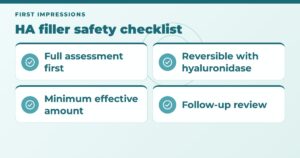
In practice, safety comes from decisions made before the needle goes in. We assess your facial anatomy and history, choose the product and depth for the area, use the smallest amount that reaches the goal, and review your results at follow-up. Our medical aesthetic nurses, who are RNs and are often searched for as nurse injectors, work within an NP-led structure, and a nurse practitioner assesses every patient before treatment. It’s the law that a Dr. or NP assesses you prior to any nurse injecting you.
Questions worth asking any injector
- Who will assess my face, and what are their credentials?
- Which products do you use, and are they authorized for use in Canada?
- How would a complication be handled, and is hyaluronidase available on site?
- What is the plan if I am not happy with the result?
How we approach fillers at First Impressions
Every filler consultation starts with a full facial assessment: facial thirds, bone structure, soft tissue, skin quality, and how your face has changed over time. The question we ask is what has been lost, where, and how much of it needs to be addressed to restore balance. We use the minimum effective amount, place it where your anatomy supports it, and adjust at later visits.
Structural support and volume are different jobs
Structural support places product deep, often near bone, to restore the scaffolding that holds overlying tissue in place. Volume addition fills space closer to the surface. Repeated volume without a structural assessment is one of the most common reasons results start to look heavy over time. At First Impressions, structural support comes first, and volume is used only in amounts that keep natural proportion.
Part Two: Neuromodulators

What neuromodulators do
Neuromodulators are prescription medications that temporarily reduce the signal between a nerve and the muscle it controls. When a muscle contracts less forcefully, the lines created by repeated movement soften and the skin over that muscle gets a rest. Health Canada authorizes specific products for cosmetic use, and the right choice for you is made at your consultation.
Beyond lines: skin quality
Researchers are also looking at what neuromodulators do for the skin itself. A 2024 systematic review and meta-analysis in Plastic and Reconstructive Surgery Global Open pooled ten studies of very small doses placed in the skin and reported improvements in texture, elasticity, pore size, oil production and wrinkles. The authors were clear that more high-quality research is needed, and this skin-level technique is different from standard treatment of the muscles. We see it as promising and still developing, not settled.
The preventative question
Many patients ask whether starting earlier prevents lines. A 2025 systematic review in the journal Muscles found that early neuromodulator treatment may reduce muscle overactivity, delay dynamic wrinkles and limit static lines (lines you can see at rest) over time. It also noted a possible remodeling effect on dermal collagen in histology studies. The authors added that the data are mixed.
Our view is that preventative treatment is a reasonable option for some people, using low doses at appropriate intervals, and decided at an individual assessment. We do not recommend it for everyone. We explore this longer-term thinking in our guide to preventative aesthetic care and skin longevity.
Natural results need precise dosing, not just less product
A common belief is that natural results come from using less product. In practice, natural results come from treating the right muscles with the right amount. Under-treating can leave part of a muscle active and produce uneven movement. Muscle anatomy varies from person to person, so an assessment that looks at your movement patterns, your history and your goals matters before every treatment.
Realistic expectations
Neuromodulators usually reach full effect within about two weeks, and results last around three to four months for most people. Timing varies with metabolism, muscle strength and treatment history. They do not stop aging. They reduce repetitive movement, delaying dynamic wrinkles and limiting the strength of static lines, while letting your face keep its expression and character.
Fillers, Neuromodulators and Skin Quality Together
Fillers and neuromodulators work on different causes of change. Muscle activity creates dynamic lines, long term repeatative activity creates static lines. Volume loss and structural change create hollowing and shifts in proportion. Many plans combine both, in the right amounts and the right order, with time between visits to see how your face responds.
Injectables work on structure and movement, and skin quality sits underneath both. Our guide to protecting the skin you are building covers how to look after it between treatments. Treatments such as microneedling with PRP can support skin quality alongside injectables, and skin quality treatments such as our V2 Beauty Booster can fit into a longer plan. We also use the Smart Mirror Skin Scanner to look at skin quality alongside structure.
Before Your Appointment
- Tell us about every medication and supplement you take, including blood thinners, aspirin and anti-inflammatories. Never stop a prescribed medication on your own. We will advise you.
- Avoid alcohol for about 24 hours before treatment, as it can increase bruising.
- Arrive without heavy makeup so we can assess your skin and take photos.
- Bring photos or records of any previous treatments, especially if you have had filler elsewhere.
- Be honest about your treatment history. It is always easier to plan around what we know.
- Ask every question you have. A good consultation is a conversation.
Preview Your Results Before You Book
First Impressions is one of only a few clinics using the Ageless AI results preview, which lets you upload a photo and see a simulation of possible outcomes before your consultation. It is a starting point for conversation, not a promise of results. For patients who are curious or unsure, it is a helpful way to talk about what a conservative plan could look like.
Frequently Asked Questions
Can HA filler be dissolved?
Yes. An enzyme called hyaluronidase breaks down HA filler. It can mean losing some or all of the result, which is why we aim to get the amount and placement right the first time.
Can PLLA filler be dissolved, and what about calcium hydroxylapatite pr PMMA fillers?
No. None of them can be dissolved the way HA filler can. Calcium hydroxylapatite is made of tiny calcium-based microspheres suspended in a gel, and poly-L-lactic acid (PLLA) is a biodegradable material. Both work partly by prompting your body to produce collagen. Polymethylmethacrylate (PMMA) is made of tiny synthetic microspheres that stay in the tissue permanently. Hyaluronidase, the enzyme that breaks down HA filler, has no effect on any of them.
Calcium hydroxylapatite and PLLA are absorbed gradually by the body over months to years, so they are not permanent, but there is no way to reverse them on demand. PMMA is considered permanent. A 2020 review of the complications of non-hyaluronic fillers found that these products carry an increased risk of lumps called nodules and granulomas, and that treating them can require steroid injections, other medications or surgery. When these problems occur, the options are more limited than with HA filler.
That is why HA filler is the only type we use. If you have had any of these fillers elsewhere, tell us at your consultation. Knowing what is already in your tissue helps us plan safely.
How long do HA filler and neuromodulators last?
HA filler is temporary and is broken down gradually over approximately 8-22 months, depending on the product and area. Neuromodulator results usually last around three to four months. Your assessment will give you a more specific estimate.
Is it safe to start neuromodulators in my twenties or thirties?
Some people benefit from a low-dose, preventative approach, but the research is still developing and it is not right for everyone. A nurse practitioner assessment is the way to decide whether it makes sense for you.
What is a nurse injector, and who treats me at First Impressions?
Nurse injector is a common search term for a registered nurse who performs injectable treatments. At First Impressions our nurses are medical aesthetic nurses, and treatment is NP-led. In Nova Scotia, RNs cannot treat independently, so a nurse practitioner assesses every patient before treatment.
How do I know if a filler plan is too much?
Warning signs include a plan that adds volume to several areas at once without explaining why, no assessment of your facial structure, and pressure to book more than you asked about. A good plan explains what has changed in your face and why each area is being treated.
Start With an Assessment
To start with an assessment, book your consultation at our Sydney or Bedford clinic.
– Your First Impressions Team
firstimpressionsclinic.ca – Sydney and Bedford locations available. | Sydney: 902-322-6805 | Bedford: 902-702-2727
This article is for education and is not medical advice. Individual results and risks vary, and a consultation determines what is appropriate for you.
By Deborah Hart NP, Board Certified Nurse Practitioner and founder of First Impressions Medical Aesthetics & Rejuvenation Clinics