
Most people don’t come to aesthetic medicine because they want to look different. They come because something feels slightly off. They look tired in a way sleep doesn’t fix. They don’t recognize themselves the way they used to. And beneath that is a deeper concern, one that rarely gets said out loud: “I want to care for myself without risking who I am.”
That fear isn’t superficial. It’s intelligent. The best aesthetic outcomes don’t erase identity, they protect it. And increasingly, the most ethical, natural-looking results come from a regenerative approach: supporting the biology of aging itself, rather than chasing quick fixes or dramatic change.
Why the Real Goal Isn’t “Looking Younger”, It’s Self-Recognition
One of the most common misunderstandings about aesthetic care is that people are chasing youth. Most aren’t. What they’re actually trying to preserve is continuity, the feeling that their face still belongs to them.
Patients often worry about looking altered, overdone, or “noticeable” in ways they can’t explain or undo. That’s why the highest level of aesthetic medicine doesn’t aim to transform. It aims to protect identity through precision: knowing how far not to go, when to intervene, and when to stop.
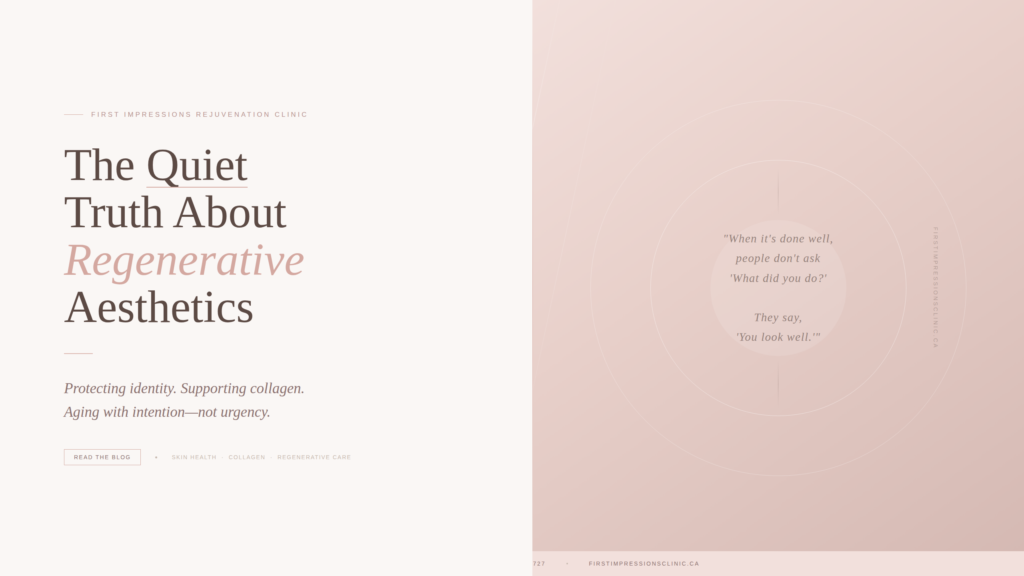
When it’s done well, people don’t ask, “What did you do?” They say, “You look good” or “You’re aging well.”
What Regenerative Aesthetics Really Means (And What It Doesn’t)
Aesthetic medicine is evolving. Where the industry once focused primarily on correction, filling lines, relaxing wrinkles, and replacing volume, modern regenerative and rejuvenation aesthetics focuses on something deeper: supporting structure, skin integrity, and long-term function.
Regenerative and rejuvenation aesthetic medicine does not attempt to “reverse” age. It works with the body’s natural repair systems to preserve dermal architecture, optimize skin performance, and maintain integrity over time. It is preventative, cumulative, and grounded in physiology.
At First Impressions Rejuvenation Clinic, regeneration and rejuvenation isn’t treated as a marketing term. It’s a clinical philosophy centered on collagen preservation, structural support, and ethical restraint, because longevity requires strategy, not excess.
Understanding Collagen: The Foundation of Skin Integrity
Collagen is the primary structural protein in the dermis. It provides:
- Tensile strength
- Elastic recoil
- Structural integrity
- Resistance to mechanical stress
Beginning in our mid-20s, collagen production declines by approximately 1% per year. This means that by the time you reach your 30’s, you may have already lost about 10-15% of your natural collagen, a trend that continues, with more significant acceleration of loss often occurring in our 40’s, 50’s and beyond, especially during menopause. At age 50, we’ve lost approximately 30-50% of our collagen, with skin becoming thinner and less elastic. By age 60, the body may be producing as little as 60% of the collagen it needs. That decline can accelerate due to ultraviolet exposure, chronic inflammation, smoking, hormonal shifts, stress and poor sleep, and repetitive muscle contraction.
Collagen loss doesn’t always show up first as deep wrinkles. It often appears subtly: skin looks thinner, fine lines linger after expression, elasticity diminishes, and recovery from stress is slower. Regenerative aesthetics aims to slow this decline and support healthier dermal architecture before collapse becomes visible.
Fibroblasts: The Cells Behind Regeneration
Fibroblasts are the cells responsible for producing collagen, elastin, and key extracellular matrix components. Healthy fibroblasts tend to thrive when the tissue environment supports them, adequate circulation, low inflammatory burden, mechanical stability, and proper hydration all matter.
When fibroblast activity declines, dermal density weakens. Treatments that stimulate fibroblasts or protect the dermal environment can meaningfully influence skin longevity. Regenerative plans focus on preserving fibroblast function over time, not overwhelming tissue with excessive intervention.
Neuromodulators as a Collagen-Protective Strategy (Not a “Frozen” Look)
Neuromodulators are often framed purely as wrinkle treatments. In regenerative and rejuvenation practice, their role can be more strategic.
Repeated muscle contraction creates mechanical stress on collagen fibers. Over time, this repetitive strain can break down dermal support, deepen etched lines, and accelerate creasing. When neuromodulators are placed conservatively and anatomically, muscle overactivity is softened and collagen is protected from repetitive folding, while expression remains intact.
Preventative neuromodulator use isn’t about freezing movement. It’s about reducing unnecessary strain, especially in areas such as:
- Glabella (frown lines)
- Forehead (when carefully balanced)
- Crow’s feet
- Lower face depressor muscles
When done thoughtfully, neuromodulation becomes part of a regenerative strategy, subtle, paced, and identity-preserving.
Skin Quality and Dermal Remodeling: The “Environment” Matters
Collagen preservation requires more than injectables. Medical-grade skin treatments that support controlled cellular turnover, hydration balance, barrier repair, and inflammation reduction help create an environment where fibroblasts can function more effectively.
Improved skin quality enhances light reflection, texture uniformity, elastic recoil, and treatment longevity. Regenerative care rarely relies on a single intervention. Instead, it layers subtle support over time, because long-term results are built, not forced.
Inflammation and “Inflammaging”: A Major Driver of Collagen Breakdown
Chronic low-grade inflammation, sometimes called “inflammaging”, is one of the most significant drivers of collagen breakdown. Common sources include poor sleep, high stress, blood sugar instability, environmental pollutants, and UV exposure.
Inflammation activates enzymes that degrade collagen fibers. That’s why regenerative and rejuvenating plans often consider more than what happens in the treatment room, including skincare that reduces oxidative stress, consistent sun protection, strategic treatment spacing, and lifestyle counseling where appropriate.
This integrative lens is one of the biggest differences between regenerative medicine and trend-based intervention.
Prevention vs. Correction: Why Starting Earlier Can Mean Doing Less
Corrective aesthetics attempts to fix visible decline. Regenerative aesthetics attempts to prevent or slow it.
When patients begin regenerative care earlier, smaller doses are often needed, structural collapse can be delayed, facial proportions remain more stable, and skin thickness is better preserved. The result is aging that appears gradual and harmonious rather than abrupt.
This is also where many people feel relief: the goal isn’t to “change your face.” It’s to support it so you can keep recognizing yourself.
Why Subtlety Is a Clinical Skill (And a Safety Standard)
Subtlety isn’t conservative, it’s precise. Overcorrection can compromise tissue integrity. Excessive filler, for example, may distort natural anatomy, stretch ligaments, impair lymphatic flow, and create long-term heaviness.
A regenerative philosophy prioritizes:
- Gradual enhancement
- Strategic placement
- Tissue preservation
- Reassessment over time
Less is often more when longevity is the goal. The highest level of care includes knowing when to pause, when to adjust, and when not to add more.
Safety Is Emotional Too: Reversibility, Pacing, and Agency
Another quiet fear sits underneath many consultations: “What if I regret this?” Not because of pain or cost, but because of permanence.
Ethical aesthetic medicine should never feel like a one-way door. It should feel paced, adjustable, and thoughtfully designed. Your face isn’t a project, it’s a living system that changes over time. Good treatment plans leave room to pause, reassess, and change direction as you change.
Reversibility isn’t a weakness in medicine. It’s good design. It gives patients agency, protects future decision-making, and lowers the emotional weight of choosing to begin.
If something feels rushed or irreversible, that discomfort is worth listening to.
Hesitation Isn’t Resistance—It’s Discernment
Many people feel stuck between wanting to start and wanting to wait. They feel pressure, from culture, mirrors, milestones, or time itself, to decide quickly. But hesitation doesn’t mean you’re behind. Often, it means you’re thoughtful.
You don’t owe youth to anyone. You don’t owe change to society. And you don’t need a dramatic reason to care for yourself.
Sometimes the right decision is to begin gently and conservatively. Sometimes it’s to wait, learn, and do nothing at all. Both are valid. The right care feels like partnership, not persuasion.
What Patients Often Notice Most: Looking Rested, Not “Done”
Patients frequently report something simple but meaningful: they look rested rather than altered. They feel more aligned with their internal energy. They may even find they need less makeup because skin quality and tone improve.
Regenerative care doesn’t create a new face. It supports the face you already have, so you can age with structural integrity, vitality, and confidence that’s sustainable.
Conclusion: Aging Is Inevitable. Collapse Is Not.
The quiet truth about aesthetic medicine is this: when it’s done properly, nothing about you disappears. You simply look like yourself, rested, supported, and undisturbed.
Regenerative and rejuvenation aesthetic medicine is not reactive. It’s strategic. By protecting collagen, supporting fibroblast function, minimizing inflammation, and using conservative, anatomy-respecting treatments, patients can maintain skin integrity and facial harmony over time.
Aging will happen. But when aesthetics aligns with biology, and when care is paced, ethical, and precise, your identity stays intact. And that has always been the point.
Happy Spring,
Your First Impressions Team
Visit us at either of our convenient locations:
Sydney
465-D George Street
902-322-6805
Bedford
620 Nine Mile Dr #103B
902-702-2727
Book your consultation online or through our app to discover how we can help you embrace your confidence journey this spring.